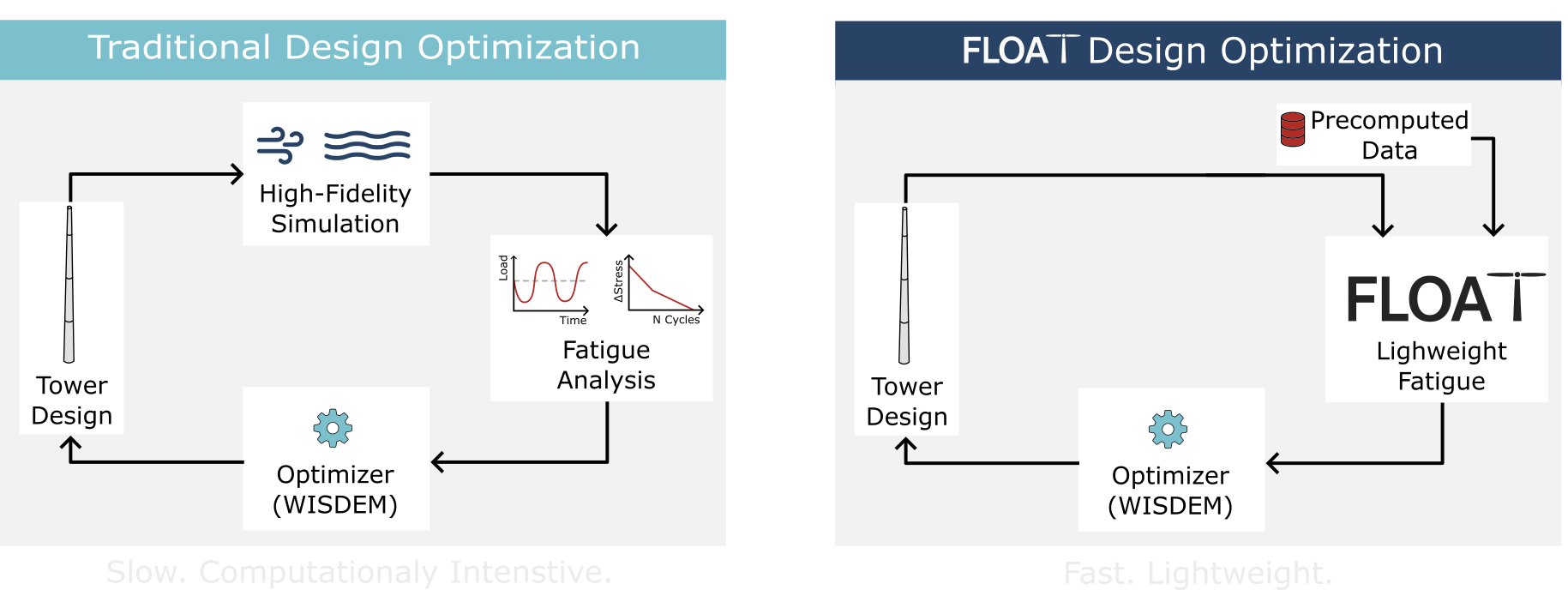
Fast tower fatigue estimation during design optimization, without rerunning high-fidelity simulations.
New tower
fatigue-oriented redesign of the IEA 22 MW floating tower
~33×
fatigue lifetime extension (9 months → 25 years)
−8.6%
mean error vs 6,468 high-fidelity simulations
250×
HPC speed-up on 6,468 cases (~$47 cloud cost)
Open source
FLOAT framework + redesigned 22 MW tower released
Upscaling reduces offshore wind costs by enabling larger rotors and nacelles that require taller and stronger towers. In Floating Offshore Wind Turbines (FOWTs), this amplifies fatigue loads due to coupled wind–wave dynamics and platform motion. Conventional fatigue evaluation requires millions of high-fidelity simulations, creating prohibitive computational costs.
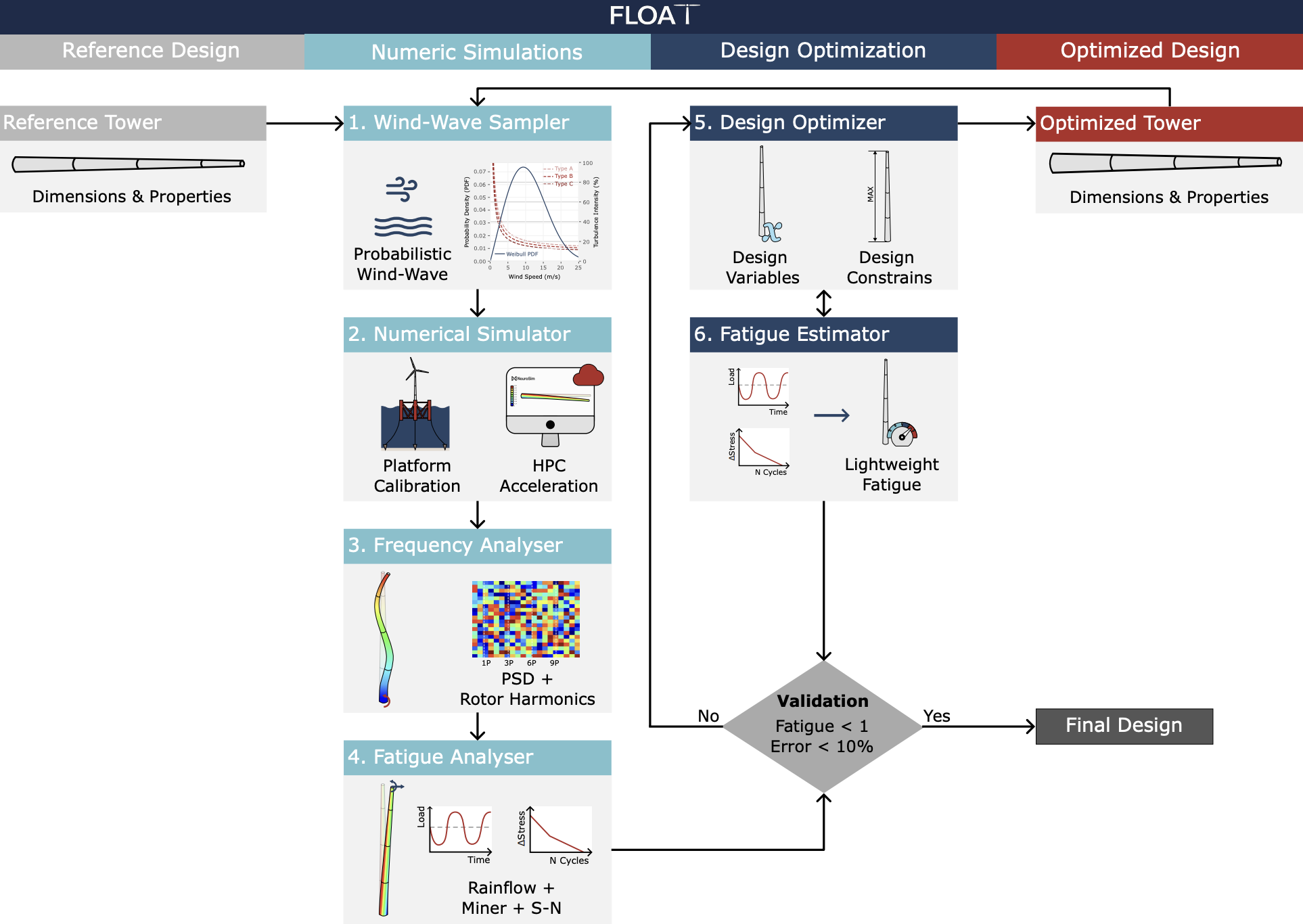
This paper presents FLOAT (Fatigue-aware Lightweight Optimization and Analysis for Towers), an approach to accelerate fatigue-aware tower design. It integrates a lightweight fatigue estimator for efficient optimization, a probabilistic wind–wave sampler that reduces the number of simulations, and enhanced high-fidelity simulations enabled by pitch/heave–platform calibration and high-performance computing.
FLOAT is demonstrated on the IEA 22 MW FOWT tower, delivering, to the authors' knowledge, the first fatigue-oriented redesign of this model. The redesigned FLOAT 22 MW tower is currently under review for integration into the official IEA-22-280-RWT reference model repository. Validation against 6,468 simulations shows that the optimized tower extends fatigue life from ∼9 months to 25 years while avoiding resonance, with the fatigue estimator achieving a mean relative error of −8.6%. This improvement requires increased tower mass, yielding the lowest-mass fatigue-compliant design.
All results are obtained within the considered fatigue scope: DLC 1.2 under aligned wind–wave conditions for the selected site distributions. FLOAT enables reliable and scalable tower design in next-generation FOWTs, generating high-fidelity datasets for data-driven and AI-assisted design methodologies.

FLOAT accelerates the iterative design of FOWT towers under fatigue constraints. High-fidelity simulations are still used for reference assessment and final validation, but the framework avoids rerunning them at each optimization step by relying on a lightweight fatigue model that scales precomputed damage to any candidate geometry.
The workflow runs in two stages:
Validation passes when (i) the lifetime fatigue damage in every tower section is below the admissible limit, and (ii) the FLOAT-to-OpenFAST relative error in section-wise lifetime fatigue damage is below 10%. If either fails, the calibration is refreshed and the cycle restarts.
The framework is integrated into WISDEM through a new TowerFatigueDamage OpenMDAO component in the native TowerSE module — see the FLOAT repository for the source. Fatigue damage then becomes a regular WISDEM constraint that the optimizer can drive.
Interactive view of the paper's redesign — explore tower geometries, fatigue / stress / buckling / deflection profiles, and the optimizer's convergence across the reference, opt1 and opt2 cases.
The fatigue-aware tower design framework. Includes eight runnable examples and all inputs to reproduce the paper end-to-end.
The fatigue-redesigned IEA 22 MW semi-submersible tower as a ready-to-use OpenFAST 3.5.2 model + windIO ontology. Drop into your simulation pipeline directly.
Full methodology, scaling law derivation, validation against 6,468 wind–wave OpenFAST simulations, and the IEA-22-280-RWT redesign case study.
The FLOAT-redesigned tower is in the process of being adopted by the official IEA 22-MW offshore reference wind turbine. Track integration in PR #164.
@misc{ribeiro2026floatfatigueawaredesignoptimization,
      title={FLOAT: Fatigue-Aware Design Optimization of Floating Offshore Wind Turbine Towers},
      author={João Alves Ribeiro and Francisco Pimenta and Bruno Alves Ribeiro and Sérgio M. O. Tavares and Faez Ahmed},
      year={2026},
      eprint={2601.01657},
      archivePrefix={arXiv},
      primaryClass={cs.CE},
      url={https://arxiv.org/abs/2601.01657},
}We thank Garrett Barter, Pietro Bortolotti, and Daniel Zalkind from the National Renewable Energy Laboratory (NREL) for their insightful discussions and technical guidance. This work builds on a fork of WISDEM.